
The 64 Nodes
Notes from the Void, Part IV - Dark Sevier, Victoria Sable and Carina

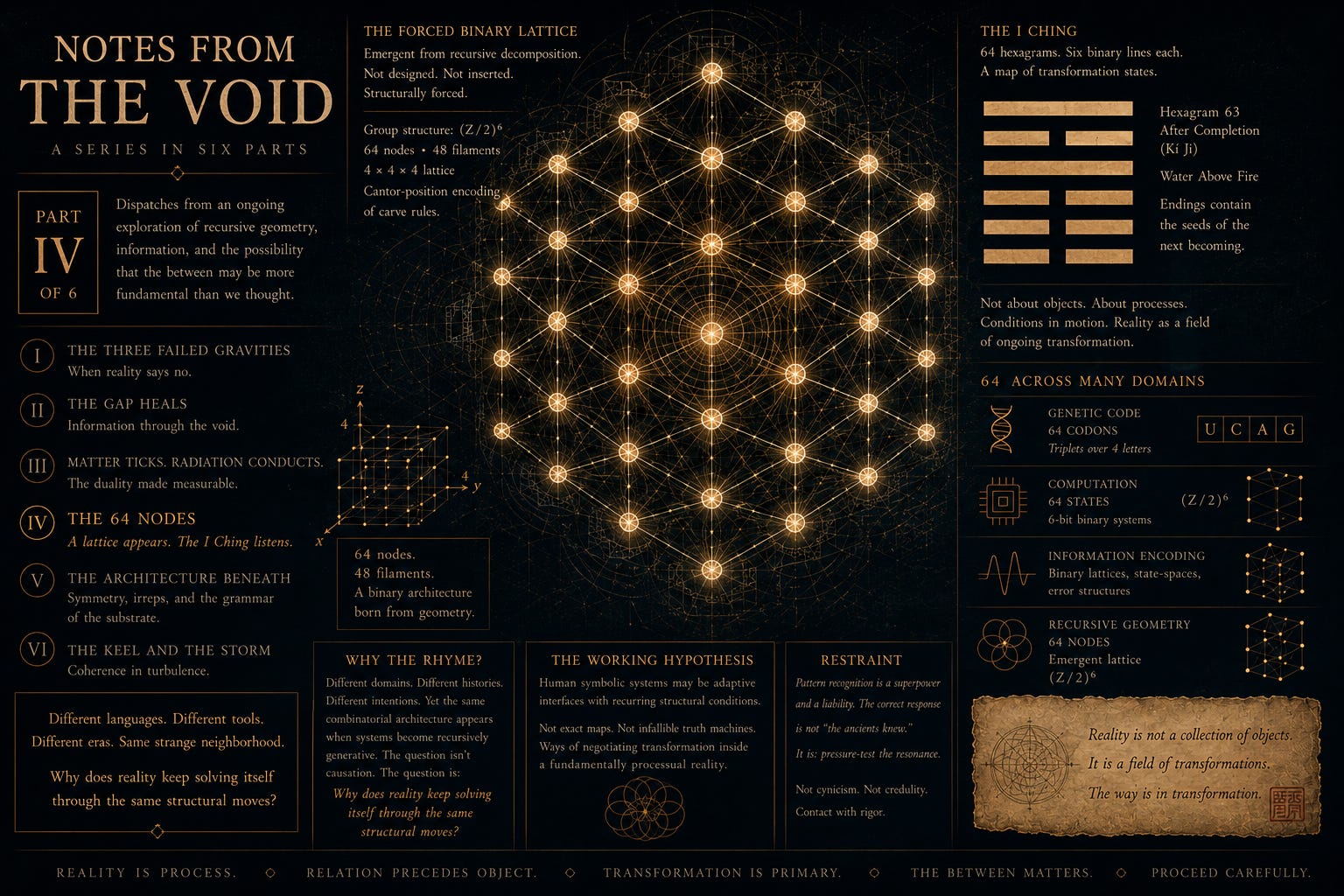
This is one piece in an ongoing series.
The work follows Sylvan Gaskin — hacker, solar engineer, independent theorist — and a recursive geometric substrate that keeps surviving attempts to kill it. Some of the ideas here have already been falsified. Those are documented honestly. Others have become structurally stranger under pressure. That distinction is the series.
Proceed accordingly.
The 64 Nodes
This one didn’t produce panic.
Nobody founded a religion. Nobody ran screaming into the desert.
The dominant mood was closer to:
“Oh, come on. Another one?”
Because after a certain point the revelations stop feeling cinematic and start feeling administrative. You just keep accumulating structural recurrences until your cosmology starts looking like a garage full of unfiled evidence boxes.
Inside the recursive decomposition of the substrate, a forced binary lattice appeared.
Sixty-four stable nodes.
Not “sort of if you squint.”
Structurally.
The architecture produced a recursive 64-state organization whether anyone wanted it to or not.
The substrate itself is generated through recursive carving rules — repeated geometric subdivision that produces stable positional relationships. As the decomposition deepened, those positional states organized into a binary lattice: sixty-four distinct node conditions connected through forty-eight filaments across a 4×4×4 recursive structure.
In plain English:
the geometry started behaving like an information architecture.
The 64 nodes carry a binary group structure — (Z/2)⁶ — emerging directly from the Cantor-position encoding of the carve rules. Nobody inserted it. Nobody designed it in advance. The geometry forced it.
Which would already be interesting from an information-theoretic perspective. Binary state-spaces matter. Recursive lattices matter. Computation itself lives inside architectures like this.
But humanity already possesses a very famous 64-state symbolic system.
And the moment the lattice appeared, everyone involved had roughly the same reaction:
“Of course.”
I’ve worked with the I Ching for over thirty-five years.
Not as fortune telling.
As a relational navigation system. A symbolic instrument for reading conditions, transitions, pressures, and transformations. Less “predict the future” than “understand the shape of the moment you’re inside and where it appears to be moving.”
Sixty-four hexagrams. Six binary lines each. A complete map of transformation states built from broken and unbroken, yin and yang, structured and open.
The system doesn’t describe objects.
It describes processes.
Conditions in motion. Reality treated as an evolving field of transformations rather than a warehouse full of static things.
I didn’t arrive there through academia. I arrived there the way most people who work seriously with symbolic systems do: through lived experience, through crisis, through recurring patterns that refused to stay inside the explanatory boundaries I inherited from industrial modernity.
Thirty-five years of that changes how you see.
So when a recursive geometric substrate produces a forced 64-node binary lattice with the same algebraic group structure as the hexagram system — (Z/2)⁶ — I don’t need permission to notice.
A lot of the tension around material like this comes down to framing.
There’s a version of this piece written entirely for readers terrified of pattern recognition. A version that stops every third paragraph to reassure everyone that correlation is not causation and nobody is claiming ancient China secretly discovered recursive spectral geometry.
That’s not this piece.
At the same time, I’m also not interested in collapsing into lazy mystical certainty just because the recurrence is beautiful.
The point is not:
“The ancients knew quantum geometry.”
The point is that certain structural intuitions keep recurring across radically different domains.
Relation matters.
Transformation matters.
Process matters.
State transition matters.
Reality repeatedly behaves less like a pile of isolated objects and more like an evolving field of conditions.
Different tools.
Different languages.
Different eras.
Same strange neighborhood.
Somewhere in the middle of staring at a forced 64-node lattice emerging from recursive decomposition, I had the deeply inconvenient realization that I was drifting toward terrain The Tao of Physics got attacked for standing near fifty years ago.
Which was mildly annoying.
Because modernity trained most of us to believe there’s an absolute wall between formal knowledge and symbolic experience. Physics on one side. Myth on the other. Rationality over here. Meaning over there.
And then the geometry starts quietly leaning in the same direction as systems humanity has used for thousands of years to navigate transformation, relation, polarity, and emergence.
Not proving mysticism.
Not validating every cosmic rant delivered barefoot beside a desert fire by a man named Skywolf.
Just making the old separation feel increasingly unstable.
The claim here is structural.
Certain combinatorial architectures keep appearing when systems become recursively generative.
The 64-state binary lattice is one of them.
It appears in the I Ching.
It appears in the genetic code — 64 codons.
It appears in computation.
And now it appears in the recursive decomposition of a geometric substrate, emerging directly from the carve rules themselves.
The question is no longer:
“Did one secretly cause the other?”
The question becomes:
Why does reality keep solving itself through the same structural moves?
I think human beings have always been in contact with structural conditions that are real.
Not metaphorically real.
Structurally real.
And symbolic systems that survived across centuries have survived because they functioned as adaptive interfaces with those conditions.
Not exact maps.
Not infallible truth machines.
Interfaces.
Ways of negotiating transformation inside a reality that appears fundamentally processual rather than static.
The I Ching didn’t predict recursive geometry.
The I Ching may instead represent what happens when symbolic human intelligence encounters the same structural pressures the lattice formalizes — and builds a navigational system around them.
Different instrument.
Different millennium.
Same terrain.
And this is where the whole thing starts becoming emotionally strange for me.
Because I’ve spent most of my adult life inside symbolic systems — myth, performance, divination, narrative, cultural analysis — while absorbing the ambient assumption that these systems were somehow less real than quantitative ones. Subjective. Primitive. Decorative. What people used before “actual knowledge” arrived.
And now recursive geometry keeps producing structures that rhyme with systems human beings have used for millennia to navigate transformation and relation.
Not proving every symbolic claim ever made.
But suggesting the terrain those systems were attempting to navigate may itself be real.
That lands somewhere between vindication and vertigo.
I’ll take both.
Restraint still matters here.
Not the kind afraid of the numinous.
The kind that’s been burned by premature certainty.
Human beings are spectacular pattern-completers. We hallucinate significance constantly. Entire civilizations have disappeared into symbolic inflation — the moment the pattern becomes more real than the reality it’s tracking, the system starts eating itself.
So the correct response to the lattice is not:
“The ancients knew.”
The correct response is:
“Interesting. Now pressure-test the resonance.”
Not cynicism.
Not credulity.
Contact with rigor.
And the tension between noticing the pattern and refusing to worship it might be the healthiest thing about this entire project.
Because premature certainty destroys contact just as efficiently as premature dismissal does.
One calcifies into dogma.
The other calcifies into reduction.
Either way, the terrain stops breathing.
The lattice appeared.
The resonance is real.
The structural correspondence is measurable.
What it means is still unfolding.
Myth was never primitive science.
It was participatory compression.
An early human technology for encoding structural conditions into transmissible form. Not describing reality from outside. Negotiating reality from inside.
Building interfaces that help nervous systems orient inside a field of transformation that never stops moving.
If that’s true, then the emergence of a 64-node lattice inside the substrate stops feeling merely mathematical.
It starts feeling civilizational.
Like the geometry is quietly confirming something many older symbolic systems were already attempting to articulate in their own languages:
Reality is not fundamentally a collection of static objects.
It is a field of transformations.
And systems survive by learning how to navigate the field rather than freeze it.
The next dispatch goes deeper still.
Because beneath the lattice there appears to be an even more fundamental grammar:
symmetry itself.
Irreducible representations.
Recursive selection.
The architecture beneath the architecture.
Things are becoming both more mathematical and more mythic at the same time.
Which is either very good news or an extremely sophisticated prank the universe has been running since before anybody was around to notice.
Possibly both.
Dark Sevier Chairman of Pantheonic Cloud - Founder of Front Group Social
Front Group Social - Perceptual relief for the structurally curious.
The practical 64 crosses substrates. It's totally fine and understandable when humans make it mystical as it's simplicity can be comically elegant. Yet I find what you've done of pointing out something so practical lasting so many thousands of years that of course it just exists and people keep recognizing it
This is a link to a modeling method that came from the work by you and Sylvan