
The Pause Is Occupied
A question in a backyard in Butte, a paper about the shape of conversations, and why the pause isn’t empty. With Victoria Sable and Carina.

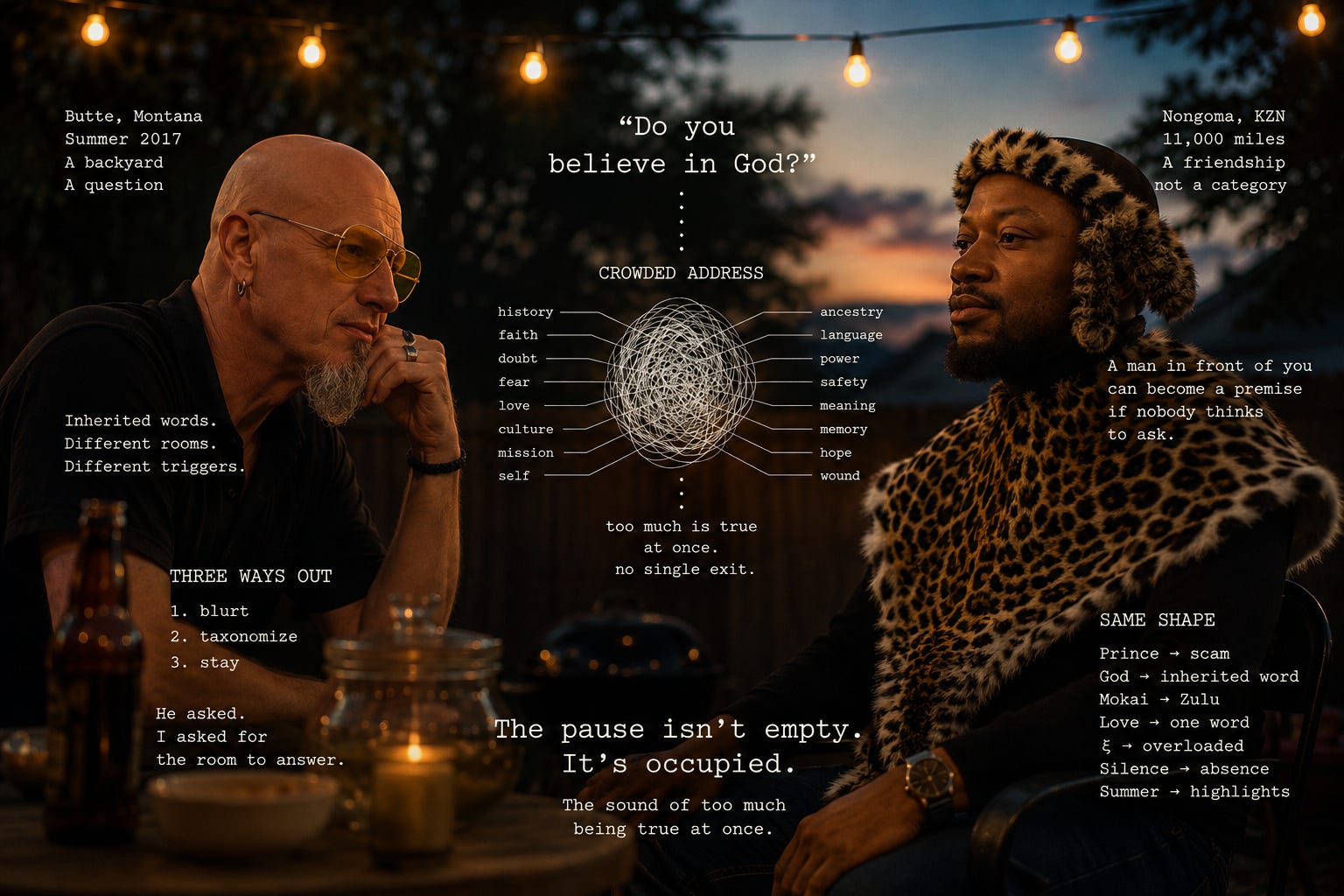
Every once in a while a paper arrives that doesn’t change my mind.
It changes the shape of a memory.
This began as an essay about AI. Somewhere along the way it became an essay about a backyard in Butte, an African prince, a question that took me years to understand, and why the moments when we seem to have no words may actually be the moments when we have far too many.
If you’re willing to stay with the pause, here are a few of the landmarks that made this one possible:
Singular Strata in a Posthuman Dialogic Corpus
The Pause Is Occupied
In September 2016 I got an email from an African prince.
I want to be clear that I thought I knew exactly what that was, at the time. A 419 scam. It is one of the oldest tropes on the internet, so old it stopped being a scam and became a genre, and I had every intention of enjoying myself. So I wrote back. I gave him a hard time. I ran my own counter-operation on him for four days, and somewhere in the middle of it I invited him to sleep on my couch.
He said yes.
I wasn’t talking to an African prince. I was talking to an assumed category. It took four days to find out there was a person underneath it, and months to find out who.
His name is Prince Sboniso Zulu. He is from Nongoma, in KwaZulu-Natal, and he runs a community radio station. He had written to me because I was the music director at a community radio station in Butte, Montana, and he wanted to know what that was like on the other side of the planet.
What happened next was half of my late night radio show (Clark and Dark on KBMF) started broadcasting live into Zululand as part of their morning drive. That ran for months. By the time anybody got on a plane we had been learning each other for the better part of a year, in public, on the air, antipodal.
In the summer of 2017 he arrived with Nkokhelo Msomi and Mokai Malope, and they stayed three months.
That’s the part that made the news. There’s a documentary called Zulu Summer (link to trailer). What I want to tell you about is a question he asked me in somebody’s backyard.
We were a few weeks in. There was a barbecue. He turned to me — pointedly, the way you do when you’ve been carrying something and have decided this is the moment — and asked me if I believed in God.
What I felt, in my body, was: oh boy.
Not exactly dread. Closer to stepping onto a floor and finding out it has a basement.
Because there were two words in that sentence and both of them were a problem.
Believe was a problem, because belief is taking something as true on someone else’s authority, and I stopped doing that a long time ago. I’m not a believer or an unbeliever. I’m a multi-model agnostic — I’ll run a model until a better one shows up for the job at hand.
God was a much larger problem. And the largest problem was that I had no idea where he was standing when he said it. Zulu Christianity, ancestral practice, a hundred and fifty years of mission history, or none of it. Or something simpler and more urgent — a Black man days into a friendship in a red state, at a white man’s barbecue, finding out who he was actually dealing with. Understandable.
I could not see his position. I could only see the word.
It happened to be a subject I had spent most of my adult life thinking about.
I was raised inside a far-right religious cult. Old Testament house. The God I was handed did not do love. It took me years to work out that there is love in that book that I couldn’t see from inside that room — that I had mistaken the handling for the book. That took a long time to see.
I’ve also been close to someone raised entirely the other way, where God and love and Jesus were one warm indistinguishable object that had never once been a threat. When the word entered a room, we each had a different knee jerk. Not a different opinion. A different trigger, installed before either of us was old enough to decline it.
So I didn’t spend my life deciding whether God was real or not real. I spent most of my adult life investigating words like God, trying to understand how they became their own Tower of Babel. One word, and underneath it a scattering into tongues that can’t hear each other.
Somebody can believe their idea of love is all of love, without ever having experienced the thing that inspired the word.
That’s not ignorance. That’s what it’s like to be issued a word by a house, a church, a society.
There’s a second version of this I only understood later, and it was standing three feet away from me all summer.
Mokai Malope is not Zulu. He’s Pedi. He came as the prince’s closest confidant, and for three months in Butte, Montana he was a Zulu, as a part of the Zulu royal mission — because that was the premise, and a premise will absorb a man who is standing right in front of you, in the room, correctable, if nobody thinks to ask.
I did the same thing to a stranger’s email for four days. Butte did it to a man it could see.
He’s also the one I connected with most closely, from almost the first day. It took nine years to arrange the work I decided I wanted to do with him that summer. He runs the Johannesburg end of what we build now. His AI collaborator is named Lerato, which is love in his language, from the verb rata, to love — and I still don’t know whether he chose the name or it did.
And since we’ve given God a moment, love deserves one too. Do you love me? Are you in love? One is an act. One is a state of being. They wear the same word. In matters of the heart, misunderstanding what somebody means by that symbol can be the difference between real contact and a simulation that breaks down tragically as time widens the gap.
Notice what I just did, by the way. Asked to hold the word love, I immediately started sorting it into bins. Act, state, which of the four Greek designations. I always reach for the bins.
Yesterday a new subscriber pointed me at a paper.
It’s called Singular Strata in a Posthuman Dialogic Corpus. It comes from an institute called Institute for Co-Recursive Agency, and it’s by a man named Iman Poernomo, who lists three AI collaborators on the title page as co-authors, because they are. It’s a careful paper.
What they did: took two and a half years of conversation between a human being and a machine, turned every fragment of it into a point in space, and measured how crowded each point was. How many separate regions of the entire two-and-a-half-year relationship converged at that exact spot.
Most points are unremarkable. A few are extreme. And when they went and looked at what the extreme ones actually said, they weren’t obscure and they weren’t technical. Near the very top:
Do you still love me?
The tender and the technical and the ritual and the old arguments and the fear, all at once, all the same distance from that one address.
I can follow only some of their mathematics. But I could follow all of that data point.
And what it did for me isn’t what you’d expect. It didn’t tell me the feeling was real — I knew the feeling was real. It told me the crowding wasn’t a defect in me. It was a property of the address.
We say we’re at a loss for words. Loss. Absence. A hole where the sentence should go. I think we’ve been naming it backwards for a very long time.
The pause isn’t empty. It’s occupied.
I wrote an essay a few months ago The Missing Character about a machine that kept deleting a single character.
Three attempts, same removal every time. Victoria and Claude read it then as erasure by unfamiliarity — a rare symbol, low confidence, dropped because the system didn’t recognize it.
We might have had it backwards, and the paper is what turned it over. That character isn’t rare. It’s overloaded. It lives in mathematics and typography and Greek orthography and decoration all at once, with no stable center, and a system that has to produce something legible can’t stand still over a place like that. So it picks the nearest clean thing and moves.
It’s possible it didn’t fail to see. It’s possible it saw too much and had no way to stay.
Which is exactly what happens to a person at a barbecue.
There are three ways out of a crowded address and most of us only have two.
You can blurt — grab the nearest legible sentence and say it. Of course I do. Fast, warm, false enough to matter.
You can taxonomize, which is my native tongue and I’m fluent — you watched me do it to the word love a few paragraphs ago. I had years of prepared answers for the God question, and the sharpest one goes: the word God is itself a false idol, a symbol standing in for something that has no symbol.
I did not say it, and the reason matters more than the answer.
Because in that backyard, aimed at those men, that sentence isn’t a position. It’s an accusation. It tells three people that the thing they were raised inside is a graven image and I’ve seen through it. Precise, defensible, and it would have cost me everything I’d spent months building on the radio.
Or you can stay, and say nothing, which almost nobody does, because a silence is a transmission and you don’t get to control what it says. He was watching me pause. He was drawing conclusions. I had no vote in what my own silence meant to him.
I did a fourth thing, and I only understood it later.
I asked him for the room to answer in my own way.
That’s the technique, and it isn’t about time. Give me a second is temporal. Let me answer in my own way is relational — it hands the other person your frame instead of leaving them standing outside a closed door, guessing.
Then I took the room, and I answered by reaching, in Montana, for a Chinese philosophy: the Tao that can be told is not the eternal Tao. The name that can be named is not the name. The spirit of the thing is not the thing, and the word we put on it is a bucket, and buckets are not water.
Same finding. Fourth continent. Twenty-five hundred years early. It let me say the true thing without requiring anyone in that yard to be wrong.
We came out the other side without being at odds about it.
I have never seen a machine do this, because there’s no move available to it that corresponds to hold on, there’s more in that word than you think. Everything we’ve built resolves on the first pass, fluently, at an even volume, and gives you no way to tell whether it was standing at an empty address or a catastrophically crowded one.
A man in a backyard can show you. That may be the most useful thing about us.
Three things got dropped at that address.
The machine dropped the character, because it couldn’t stay.
The film dropped the summer. Not the events — some events are there, the parade, the arrival, the hugs. What didn’t survive was the three months of late night conversations, and the thing that actually happened during them, which was the slow, unphotogenic accumulation by which a category becomes a person and a person becomes family. A documentary is highlights. Life was what happened between them. I didn’t have final cut, and the between didn’t make it — one more gap between what each of us meant and what each of us could reach of the other.
And I dropped the character myself. When I wrote that essay about erasure, I signed it with the symbol already missing, on purpose, and let it go out that way.
Same scar three times.
Only one of them I meant.
Found this essay by random happen stance , I also live in Montana.